


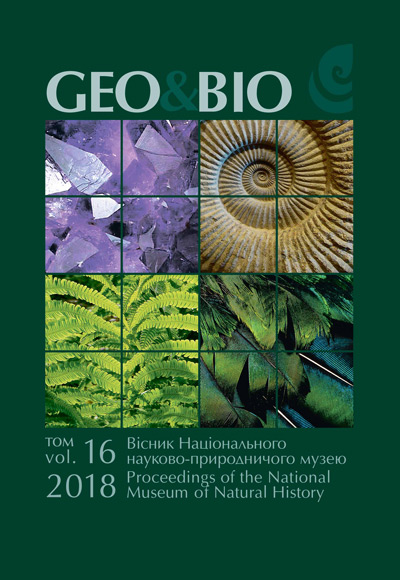
GEO&BIOContent
Про журналGEO & BIO is a scientific peer-reviewed journal published by the National Museum of Natural History, NAS of Ukraine. In 2001–2017, the journal was published under the main title “Proceedings of the National Museum of Natural History.” The journal publishes high-quality research papers in the fields of geology, palaeontology, biology, ecology, and natural history museology. The papers mostly cover various topics of geological and biological diversity as well as theoretical and practical aspects of natural history museology. About this journal
Print ISSN: 2617-6157 Aim, Scope and ObjectivesThe journal aims to present and distribute results of novel research in the fields of geology, palaeontology, zoology, botany, ecology, and natural history museology. A special focus is given to articles that describe and analyse geological and biological diversity, to studies carried out by using museum collections, as well as to contributions that deal with various theoretical and practical aspects of natural history museology and the functioning of natural history museums. Geo&Bio also publishes papers that contribute to the development and management of scientific collections and to the history and prospects of development of natural history museums as scientific and educational centres. Research papers, review articles and short communications are welcomed for submission, as well as communications into the section “History and Chronicles.” The main objectives of the journal are to publish and disseminate the results of original research, ensure independent peer review to improve the quality of articles, promote the integration of scientific knowledge, support the development of scientific schools, provide accessibility of research by Ukrainian scientists to the international community, highlight current trends, and support the development of young researchers, PhD students, and doctoral candidates through the publication of their research results. Open Access, Licensing Terms and Copyright NoticeBefore the article publication, authors sign an Open Access Agreement with a Creative Commons Attribution International CC-BY license and grant the Journal of Mechanical Engineering – Problemy Mashynobuduvannia a non-exclusive license to publish the article. The contents of the journal are freely available under the CC BY-SA 4.0 licence. The journal allows the author(s) to hold the copyright, although does not allow retaining publishing rights. All published papers can be accessed freely on the journal's website (Archives) and on the website of Vernadsky National Library of Ukraine — the main repository of the National Academy of Sciences of Ukraine. Submission of ManuscriptsSubmission of a manuscript implies that it has not been published and currently is not under consideration for publication in another journal. Manuscripts along with a cover letter should be sent by the Corresponding author to the editorial office via email to the following address: geobio.journal@gmail.com The submitted materials should be designed in accordance with the author guides, which can be found on the page “Guide for Authors ( >>>).” Additionally, any paper published in the latest volume can be used as a sample. Submission and publication of manuscripts are free of charge. Policy for author feesAuthors do not bear any costs related to the submission, processing, or publication of articles in the journal. “GEO&BIO” does not charge fees for manuscript submission, editorial processing, peer review, translation of articles into or from English, publication in both print and online formats, preparation of metadata for bibliographic systems, or other services associated with article handling. In particular, “GEO&BIO” does not impose charges for the processing, reviewing, and/or publication of articles submitted by doctoral students (third level of higher education) enrolled in state-funded programs, provided that such articles are prepared individually (without co-authors). However, the journal does not provide authors with free printed copies of the issue. Editorial Process and Plagiarism PreventionAll correspondence between the editorial office and the Corresponding author is carried out via email. The Corresponding author is responsible for submitting the manuscript and additional files (figures, graphs, tables, etc.) to the journal and for managing the manuscript during the review process. (for detailed info see: Editorial Policy >>>). Materials submitted by the Corresponding author undergo preliminary (editorial) review by the Chief Editor or one of the Subject or Associate Editors. This process is mandatory and aimed to analyse that the submitted materials meet the topics of the journal, presented results are novel and relevant for the scientific community, and the design of the manuscript meets the prescribed criteria. Afterwards the manuscript is sent back to the Corresponding author to consider editorial remarks and prepare the manuscript for external peer-review. All papers (except for chronicles and information) are sent for peer-review. The Editorial Board selects peer-reviewers without consultations with the authors. The peer review process is single-blind. The number of peer-reviews is usually two, although, if needed, additional peer-review can be also appointed. The aim of the peer-review process is to obtain conclusions from professionals in the corresponding research area about the quality of the submitted paper and expediency of publication of materials presented. The peer review process usually lasts for a month, after which the Corresponding author receives the reviewers’ comments with additional editorial advice. The reviewers’ name remains unknown for the author(s) except when the reviewer himself/herself asks for revealing his/her name. When peer reviewers' assessments contradict, the Editor-in-Chief makes the final decision whether to publish or not the manuscript. During both editorial process and external peer review, the submitted manuscript is thoroughly checked for plagiarism and is immediately rejected should any sign of unethical data use be revealed. Preparation of the manuscript for publication starts when the peer-review process is completed and the Editorial Board has accepted the manuscript. This process usually consists of three stages of corrections, such as scientific, technical, and language proofreading. The Corresponding author receives all intermediary and the final version of the manuscript, particularly after (1) submission with preliminary editorial remarks, (2) peer-review with the reviewers’ comments, (3) scientific and technical corrections and language proofreading, (4) the galley proof is prepared, and (5) the final pdf file has been sent to the publisher. The journal «GEO&BIO» uses Detector Plagiarist software and https://justdone.com/ to detect instances of overlapping and similar text in submitted manuscripts. Manuscripts in which plagiarism or textual borrowings are found without reference to the original source are rejected by the editorial board for publication in the journal. Plagiarism before publication The journal «Zoodiversity» will judge any case of plagiarism on its own merits. If plagiarism is detected, either by the editors, peer reviewers or editorial staff at any stage before publication of a manuscript - before or after acceptance, during editing or at page proof stage, we will alert the author(s), asking her or him to either rewrite the text or quote the text exactly and to cite the original source. If the plagiarism is extensive - that is, if at least 25% of the original submission is plagiarized - the article may be rejected and the author's institution/employer notified. Policy of checking for plagiarism The manuscripts in which plagiarism is detected are handled based on the extent of plagiarism present in the manuscript: if < 25% plagiarism – the manuscript is immediately sent back to the authors for content revision, and if > 25% plagiarism – the manuscript is rejected without editorial review. The authors are advised to revise the plagiarized parts of the manuscript and resubmit it as a fresh manuscript. The percentage of plagiarism is calculated by software and also assessed manually. Plagiarism after publication If plagiarism is detected after publication, the Journal will conduct an investigation. If plagiarism is found, the journal editorial office will contact the author's institute and funding agencies. The paper containing the plagiarism will be marked on each page of the PDF. Depending on the extent of the plagiarism, the paper may also be formally retracted. Recommendations for avoiding plagiarism:
Authors are responsible for obtaining copyright permission for reproducing illustrations, tables, figures taken from other authors and/or source. Permission must be placed at the foot of each figure. Self-Plagiarism Most editors and reviewers would argue that self-plagiarism is unethical. Thus, an author cannot copy one’s own material for a new manuscript without permission of the copyright holder. Alternatives include using quotes around short phrases of own work and citing appropriate references. Use of artificial intelligence
Procedure for Handling Complaints on Violations of Academic Integrity and EthicsThe journal upholds high standards of publication quality and carefully reviews all reports of violations of academic integrity and ethics (including data fabrication or falsification, plagiarism, improper authorship, etc.) in accordance with the principles of the Committee on Publication Ethics (COPE). Authors and co-authors bear full responsibility for compliance with these principles. Submission of a ComplaintComplaints regarding violations of academic integrity should be sent by email to: geobio.journal@gmail.com. A valid complaint must be clear, specific, and supported by evidence. It should include: contact details of the complainant; a reference (link) to the publication in question; a detailed description of the violation with supporting evidence. Anonymous complaints are not considered. Consideration of the ComplaintPreliminary stage 1. The Editor-in-Chief appoints an authorised person to conduct a preliminary assessment. 2. Within 10 working days, the authorised person verifies: whether the complaint falls within the journal’s scope; whether sufficient grounds exist for further consideration. 3. The complainant is notified of the complaint’s registration or refusal. Review stage 1. A committee of three independent experts is established to review the complaint. 2. The committee may: request additional materials and explanations; involve independent experts; consult with all parties concerned. 3. The review period shall not exceed 30 calendar days. Decisions and Measures 1. After review, the committee may: reject the complaint as unfounded; recognise the violation as minor and recommend corrections; recognise the violation as serious and take appropriate measures. 2. Possible measures in cases of serious violations include: rejection of the manuscript; retraction of a published article; temporary ban on manuscript submissions; notification of the author’s institution. Protection of the Rights of the Parties1. All parties involved have the right to: receive full information about the review process; present explanations and evidence; appeal the committee’s decision. 2. Confidentiality of the process is guaranteed for all participants. Appeals1. The committee’s decision may be appealed to the Editor-in-Chief within 14 days. 2. The Editor-in-Chief considers the appeal within 10 working days. 3. The decision of the Editor-in-Chief is final. Authors and co-authors bear full responsibility for compliance with the principles of academic integrity and publication ethics. Retraction Policy (Withdrawal of Published Articles)Retraction of a published article is a formal mechanism for correcting the scholarly record and informing readers that a publication contains flaws or ethical violations. Retractions may be issued when legal, publishing, or ethical standards have been breached. The editorial board follows the Committee on Publication Ethics (COPE) guidelines on corrections and retractions, upholding principles of academic integrity and accountability to readers. Grounds for RetractionAn article may be retracted for reasons including:
Initiation of RetractionRetraction may be initiated by:
Retraction Procedure
Archiving Policy and Long-Term Open Access PreservationThe journal guarantees long-term digital preservation and free access to all published materials, in line with open access principles. This is achieved through the following measures: • Repositories Full-text access to all journal publications is available in real time via the “Archive” section on the official journal website. The archive includes all issues and individual articles without time restrictions. To safeguard against data loss, the electronic archive is also deposited in the National Library of Ukraine named after V. I. Vernadsky. • Technical Measures All materials are stored in stable electronic formats that ensure accessibility, reproducibility, and proper citation in the future. Metadata and full texts are indexed in both national and international information and scientometric systems. • Accessibility Guarantees The journal uses sustainable file formats (PDF/A) to ensure long-term readability of scientific content. Each document is assigned a DOI, guaranteeing discoverability. The journal complies with Open Access standards. All materials are freely available through the journal’s website, the National Library of Ukraine named after V. I. Vernadsky, and other specilaised databases. Abstracted and Indexed in
|